





 Weather Radar
1. Introduction to Weather Radar
RADAR stands for RAdio Detection And Ranging. Invented just before World War II for military purpose, it has since been applied to many areas, an important one being weather monitoring. Through detecting raindrops in the atmosphere, the weather radar is a very effective tool for monitoring severe weather such as tropical cyclones, thunderstorms and heavy rain.
A weather radar detects rain in the atmosphere by emitting pulses of microwave and measuring the reflected signals from the raindrops. In general, the more intense the reflected signals, the higher will be the rain intensity. The distance of the rain is determined from the time it takes for the microwave to travel to and from the rain.
Doppler weather radar has become increasingly popular in recent years. It is capable of measuring the approach (or departing) speed of raindrops. The Doppler principle can be explained by noting the change in pitch of an ambulance siren. The pitch heightens as the ambulance approaches and lowers as it departs. In other words, the faster the ambulance approaches, the higher will be the pitch. For the case of a Doppler radar, the faster the raindrops move towards the radar, the higher will be the frequency (i.e. pitch) of the microwave reflected from raindrops (Fig. 1). The raindrops' approach speed is determined by the frequency shift, and provides a good estimation of the winds, which carry the raindrops.
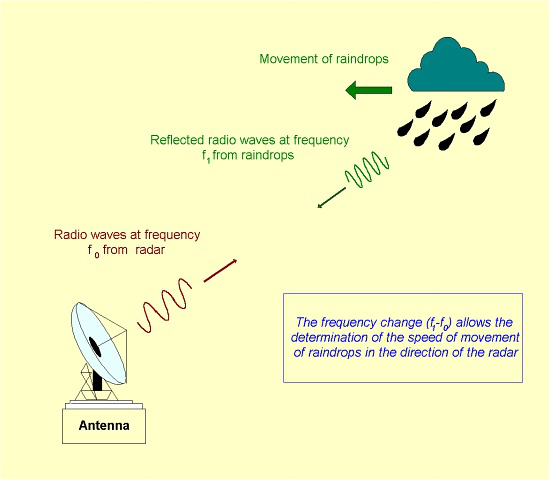
Fig. 1 Working principle of a Doppler weather radar.
2. Doppler Radar
2.1 Introduction to Doppler Radar
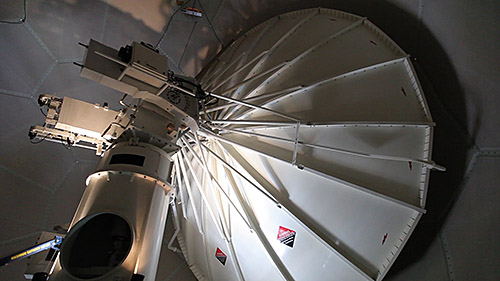
The Weather Surveillance Radar (WSR) - 88D
The most effective tool to detect precipitation is radar. Radar, which stands for Radio Detection and Ranging, has been utilized to detect precipitation, and especially thunderstorms, since the 1940's. Radar enhancements have enabled NWS forecasters to examine storms with more precision.
The radar used by the National Weather Service in the U.S.is called the WSR-88D, which stands for Weather Surveillance Radar - 1988 Doppler (the prototype radar was built in 1988).
As its name suggests, the WSR-88D is a Doppler radar, meaning it can detect motions toward or away from the radar as well as the location of precipitation areas.
This ability to detect motion has greatly improved the meteorologist's ability to peer inside thunderstorms and determine if there is rotation in the cloud, often a precursor to the development of tornadoes.
2.2 How radar works
The basics of radars is that a beam of energy, called radio waves, is emitted from an antenna. As they strike objects in the atmosphere, the energy is scattered in all directions with some of the energy reflected directly back to the radar.
The larger the object, the greater the amount of energy that is returned to the radar. That provides us with the ability to "see" rain drops in the atmosphere. In addition, the time it takes for the beam of energy to be transmitted and returned to the radar also provides is with the distance to that object.
Doppler radar
By their design, Doppler radar systems can provide information regarding the movement of targets as well as their position. When the WSR-88D transmits pulses of radio waves, the system keeps track of the phase (shape, position, and form) of those pulses.
By measuring the shift (or change) in phase between a transmitted pulse and a received echo, the target's movement directly toward or away from the radar is calculated. This then provides a velocity along the direction the radar is pointing, called radial velocity. A positive phase shift implies motion toward the radar and a negative shift indicates motion away from the radar.
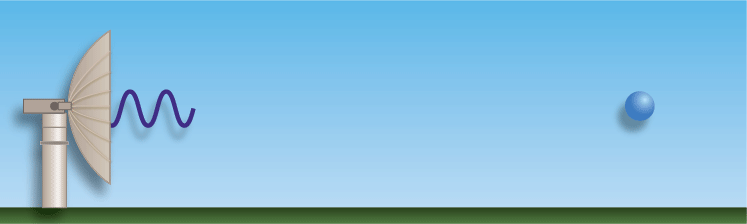
Doppler radar sends the energy in pules and listens for any returned signal.
The phase shift effect is similar to the "Doppler shift" observed with sound waves. With the "Doppler shift", the sound pitch of an object moving toward your location is higher due to compression (a change in the phase) of sound waves. As an object moves away from your location, sound waves are stretched resulting in a lower frequency.
You have probably heard this effect from an emergency vehicle or train. As the vehicle or train passes your location, the siren or whistle's pitch lowers as the object passes by.
Doppler radar pulses have an average transmitted power of about 450,000 watts. By comparison, a typical home microwave oven will generate about 1,000 watts of energy. Yet, each pulse only lasts about 0.00000157 seconds (1.57x10⁻⁶), with a 0.00099843-second (998.43x10⁻⁶) "listening period" in between.
Therefore, the total time the radar is actually transmitting (when the duration of transmission of all pulses each hour are added together), the radar is "on" for a little over 7 seconds each hour. The remaining 59 minutes and 53 seconds are spent listening for any returned signals.
The NWS Doppler radar employs scanning strategies in which the antenna automatically raises to higher and higher preset angles, called elevation slices, as it rotates. These elevation slices comprise a volume coverage pattern (VCP).
Once the radar sweeps through all elevation slices a volume scan is complete. In precipitation mode, the radar completes a volume scan every 4-6 minutes depending upon which volume coverage pattern (VCP) is in operation, providing a 3-dimensional look at the atmosphere around the radar site.
Dual-Polarization
An addition to the NWS Doppler radar has been of dual-polarization of the radar pulse. The "dual-pol" upgrade included new software and a hardware attachment to the radar dish that provides a much more informative two-dimensional picture.
Dual-pol radar helps NWS forecasters clearly identify rain, hail, snow, the rain/snow line, and ice pellets improving forecasts for all types of weather.
Another important benefit is dual-pol more clearly detects airborne tornado debris (the debris ball) - allowing forecasters to confirm a tornado is on the ground and causing damage so they can more confidently warn communities in its path. This is especially helpful at night when ground spotters are unable to see the tornado.
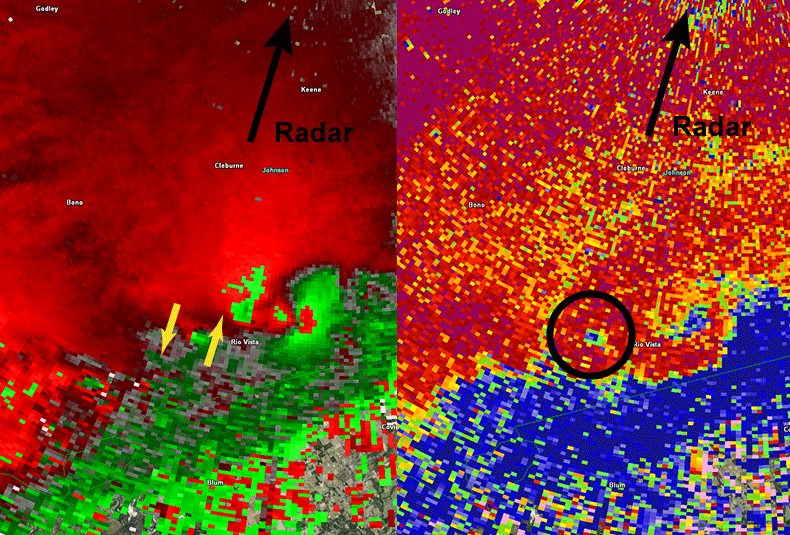
These two images show how dual-polarization helps the NWS forecaster detect a tornado producing damage. The left image shows how the Doppler radar can detect rotation. Between the two yellow arrows, the red color indicates outbound wind while the green colors indicated inbound wind relative to the location of the radar.
Prior to dual-polarization, this is all we knew that there is a rotation near the earth's surface. Unless there were storm spotters visibly watching the storm we would not know for certain that a tornado was present.
The right image shows how dual-polarization information helps detect debris picked up by the tornado so we have confidence of a tornado as these two areas coincide.
Fast Facts
All modern radars are Doppler radars. Therefore the old-time radar sweeping line is no longer applicable.
Some local television stations continue to show a sweeping radar on their broadcast however.
The sweeping arm is fake. The radar image itself may be valid but the sweeping arm is added by the computer.
Even if it appears an image updates once the line passes any particular storm, that sweeping line is computer generated and not real.
2.3 Radar Images
Radar Images: Reflectivity
Note: By their nature, radar images use color as a means of communicating information. This can be a problem for people with color vision deficiency. Visolve is a software application (free for personal use) that transforms colors of the computer display into the discriminable colors for various people including people with color vision deficiency, commonly called color blindness.
Reflectivity images are just as they sound as they paint a picture of the weather from the energy reflected back to the radar. Reflectivity images are the vast majority of radar images you will see on television as well. There are two types available on the web; Base Reflectivity (½° elevation) and Composite Reflectivity.
Base Reflectivity
Taken from the lowest (½°) elevation scan, base reflectivity is excellent for surveying the region around the radar to look for precipitation.
This image (below) is a sample base reflectivity image from the Doppler radar in Frederick, OK. The radar is located in the center of the image.
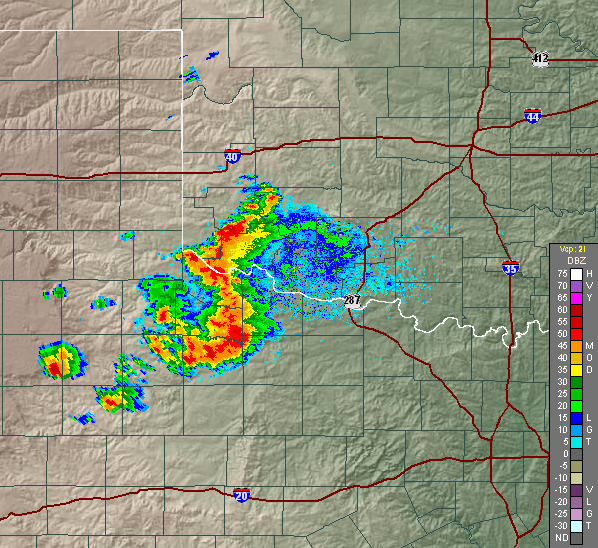
A Base Reflectivity image indicating precipitation.
The colors represent the strength of returned energy to the radar expressed in values of decibels (dBZ). The color scale is located at the lower right of each image. As dBZ values increase so does the intensity of the rainfall.
Value of 20 dBZ is typically the point at which light rain begins. The values of 60 to 65 dBZ is about the level where 1" (2.5 cm) diameter hail can occur. However, a value of 60 to 65 dBZ does not mean that severe weather is occurring at that location.
Severe weather may be occurring with values less (or greater) than 60 to 65 dBZ due to...
Hail that is totally frozen (without a thin layer of water in the surface). "Dry hail" is a very poor reflector of energy and can lead to an underestimate of a storm's intensity.
Atmospheric conditions such a ducting. When ducting occurs, the radar beam is refracted into the ground (indicating stronger storms than what are actually occurring). However a worse case is when subrefraction is occurring and the beam is overshooting the most intense regions of storms (indicating weaker storms than what are actually occurring).
Doppler radars that get out of calibration. The radar can become "hot" (indicating stronger storms than what are actually occurring) or "cold" (indicating weaker storms than what are actually occurring).
The radar beam spreads with distance meaning the most intense part of the storm's reflected returns will be averaged with the weaker portions leading to an overall appearance of lower intensity.
And, last but not least, the radar beam increases in elevation as distance increases from the radar.
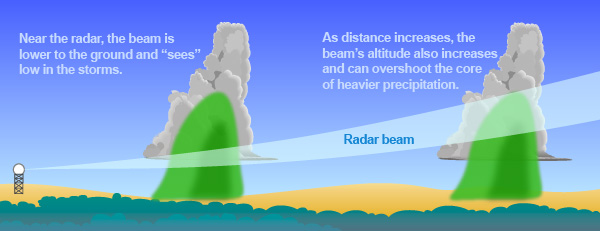
At increasing distance, the radar is viewing higher and higher in storms and the beam may overshoot the most intense parts.
Composite Reflectivity
When all returns from all elevation scans are compiled an image is created which takes the highest dBZ value from all elevations, called Composite Reflectivity. It is a picture of the strongest returns from all elevations.
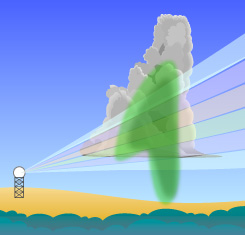
Composite Reflectivity looks at ALL elevation scans in order to create an image.
When compared with Base Reflectivity, the Composite Reflectivity can reveal important storm structure features and intensity trends of storms. This is important because often during the development of strong to severe thunderstorms, rain-free areas (or areas with light rain) develop as a result of strong updrafts.
Yet, because it requires all elevation scans to be completed, unlike the Base Reflectivity being the first image created, Composite Reflectivity is the last image created in each volume scan.
Therein lies an important point when viewing composite reflectivity images; always check the time of the image. Often, the base reflectivity image and composite reflectivity image will not have the same time with the base reflectivity image being the most recent.
When compared with Base Reflectivity, the Composite Reflectivity can reveal important storm structure features and intensity trends of storms.
This is important because often during the development of strong to severe thunderstorms, rain-free areas (or areas with light rain) develop as a result of strong updrafts.
In the loop (below) it will change to the base reflectivity image from the same time as the composite view. The first thing you will notice about the composite image is there is much more "green" color near the radar, located at the center.
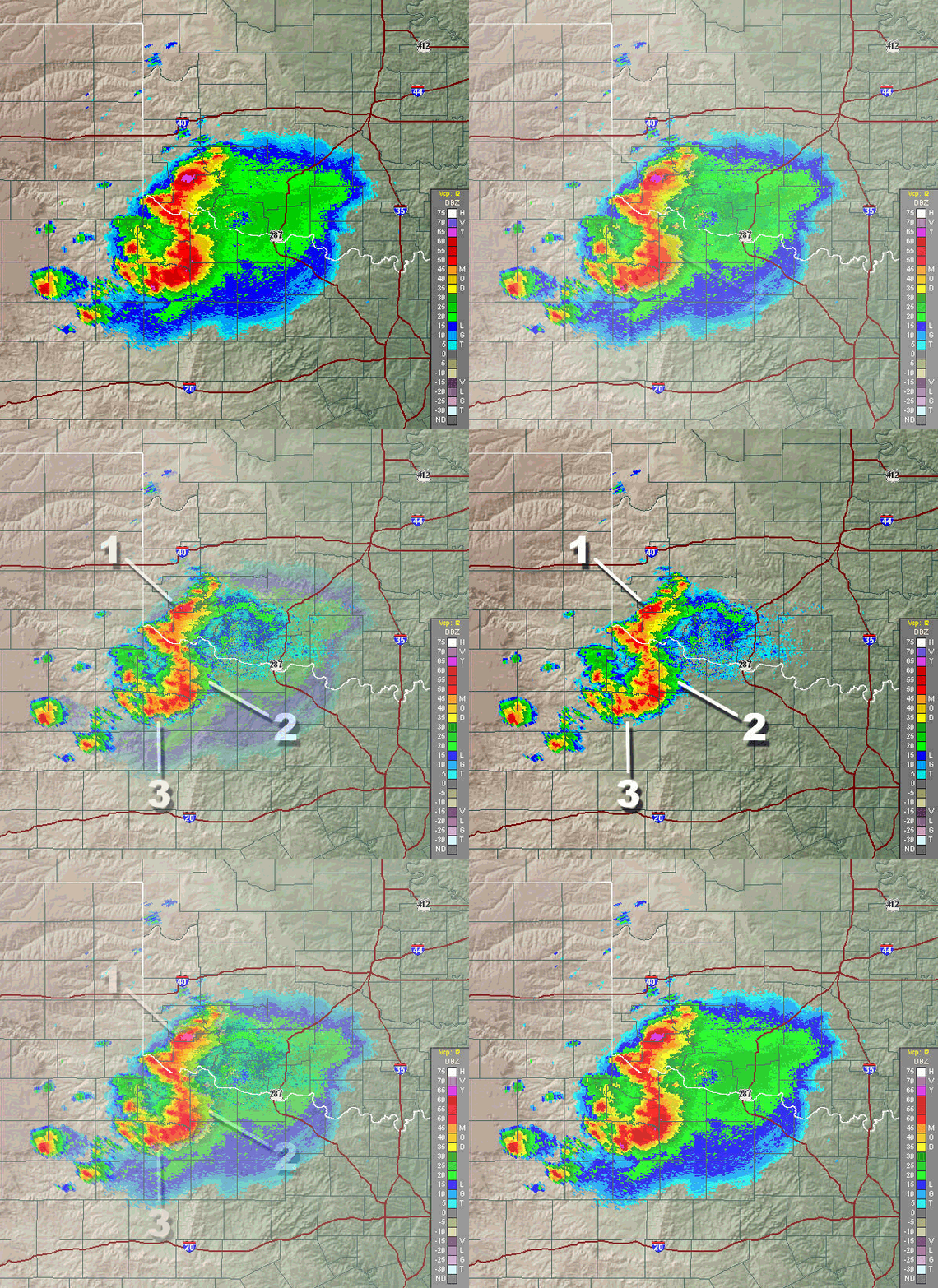
When higher elevation scan information is included in the composite reflectivity, it appears to indicate more widespread rain.
However, the base reflectivity images does not show that rain so it is probably not reaching the ground but evaporating as it falls from very high in the atmosphere.
Evidence of very strong updrafts (leading to the possibility of severe weather) can be seen when comparing the two images. At #1, the fuschia colored region, visible on the composite image, is all but missing on the base reflectivity.
Remember the old adage "What goes up, must come down", using the color scale, this area is at 65 dBZ on the composite image. It is an area of concern as this is probably hail that has yet to fall. Some or most of the hail may melt before reaching the ground but at the very least, intense, blinding rain may be about to occur near this location.
The notches, at #2 and #3, show more rain supported by strong updrafts. Those locations require additional interrogation to determine what is taking place at these locations which will come from the velocity products.
One other note of caution, due to the time it takes to produce and transmit an image, all radar images show what HAS happened and NOT NECESSARILY WHAT IS happening.
Fast Facts
The dBZ values equate to approximate rainfall rates indicated below.
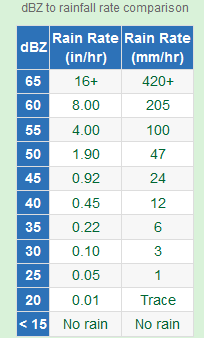
These are hourly rainfall rates only and are not the actual amounts of rain a location receives. The total amount of rain received varies with intensity changes in a storm as well as the storm's motion over the ground.
Radar Images: Velocity
What separated the Doppler radar from previous generation NWS radars is its ability to detect motion. The motion it sees are primarily rain drops carried along by the wind but also can detect motions of insects, birds, and smoke particles.
However, the only motion it can "see" is called radial velocity. This motion is NOT the direction of the wind but the portion of the wind's motion that is moving either directly toward or away from the radar.
The motion of the wind, relative to the radar, is broken down into two components...
the motion perpendicular to the radar beam and
the motion along that radial (either directly toward or away from the radar).
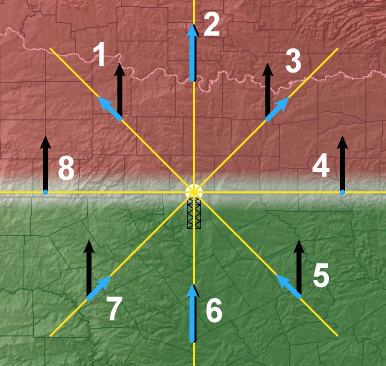
Various radial velocities associated with a south wind. Yellow is the direction the radar is pointing. Black arrows represents the wind direction and the length represents the wind speed. Blue arrow lengths represent the speed the radar "sees" along that direction.
In the graphic above, the wind is moving from south to north (indicated by the black arrows). North of the radar (red shading) the wind is moving away from the radar. As the radar sweeps from position 1 to position 2, the beam becomes more and more inline with the overall wind flow.
As it does, the radar "sees" an increase in the radial velocity away from the radar. At position 2, the radial velocity is the same as the overall wind speed. Then, as the radar sweeps to position 3 the radial velocity begins to decrease.
At position 4 (and 8) the wind is blowing perpendicular to the radar beam. Since there is no motion toward (or away) from the radar, it "sees" zero motion. However, the wind IS NOT calm at these points as it is still blowing from the south. This is just the area of zero radial velocity.
Positions 5, 6, and 7, in the green shading, are like 1, 2, and 3 in the red shading except the wind is moving toward the radar. The greatest radial velocity is at position 6 where the wind is blowing directly at the radar.
These observed radial motions are vectors, meaning that the length of the arrows indicates the speed of the wind; the longer the arrow, the faster the speed. The Doppler radar calculates a velocity base on the length of these vectors and creates a color coded graphics for display. In these velocity graphics, red colors indicate wind moving away from the radar with green colors indication wind moving toward the radar.
The brighter the reds and greens the greater the radial velocity and a more representation of the true wind speed. The NWS in the U.S. provides two velocity images: Base velocity and Storm Relative Motion.
Base Velocity
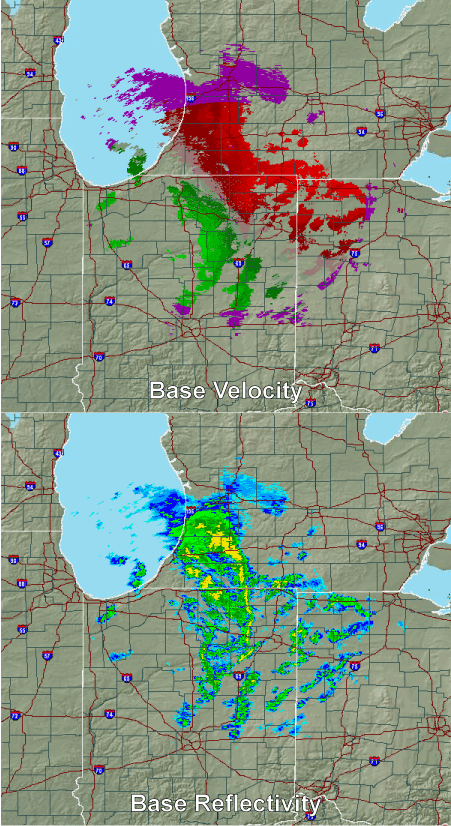
Base velocity and Base reflectivity
Base velocity, like Base reflectivity, provides a picture of the basic wind field from the lowest (½°) elevation scan. But to see the wind there needs to be radar "returns" before the radar can determine the velocity.
In this comparison (above) between the Base velocity and Base reflectivity, you will notice there is hardly any velocity information outside of the areas of precipitation. But with precipitation, Base velocity is useful for determining areas of strong wind from downbursts or detecting the speed of cold fronts.
Remember, the radar beam elevation increases with increasing distance from the radar. Therefore, the reported value will be for increasing heights above the earth's surface.
Also, know WHERE the radar is located in the image. The radial velocity colors only has the proper meaning if you know how it is blowing relative to the location of the radar. Outbound winds (red colors) on one radar might be inbound winds (green colors) at an adjacent radar. If the radar cannot determine (called range folding) inbound or outbound then it paints the wind in purple.
Storm Relative Motion
When looking for rotation in thunderstorms (trying to determine if there is a tornado) the overall motion of the storm can mask any storm circulation as seen in a Base velocity image. If the overall motion of the storms is subtracted from the velocity, the wind circulation relative to the storm itself will become more evident.
The Storm Relative Motion image is does just that. It is a picture of the wind circulation around a storm when the overall motion of the storm is subtracted. In effect, what is seen is the wind's motion as if the storm was stationary.
As before, the radar will only see the radial velocity. For small scale thunderstorm circulations, from which tornadoes often form, will typically be indicated by strong inbound wind located along side strong outbound wind relative to the radar.
When looking at Storm Relative Motion it is very extremely important to know where the radar is located. Tornadic circulations are cyclonic (counter-clockwise). So adjacent red and green colors need to be on the proper side in order to determine if there is a possible tornadic signature.
The loop (below) shows the comparison of the Base velocity and Storm Relative Motion. The yellow dot in the center of the image is the radar's' location. Recall from Base Reflectivity the notch in the precipitation pattern at #2. The Base velocity image shows mainly green colors.
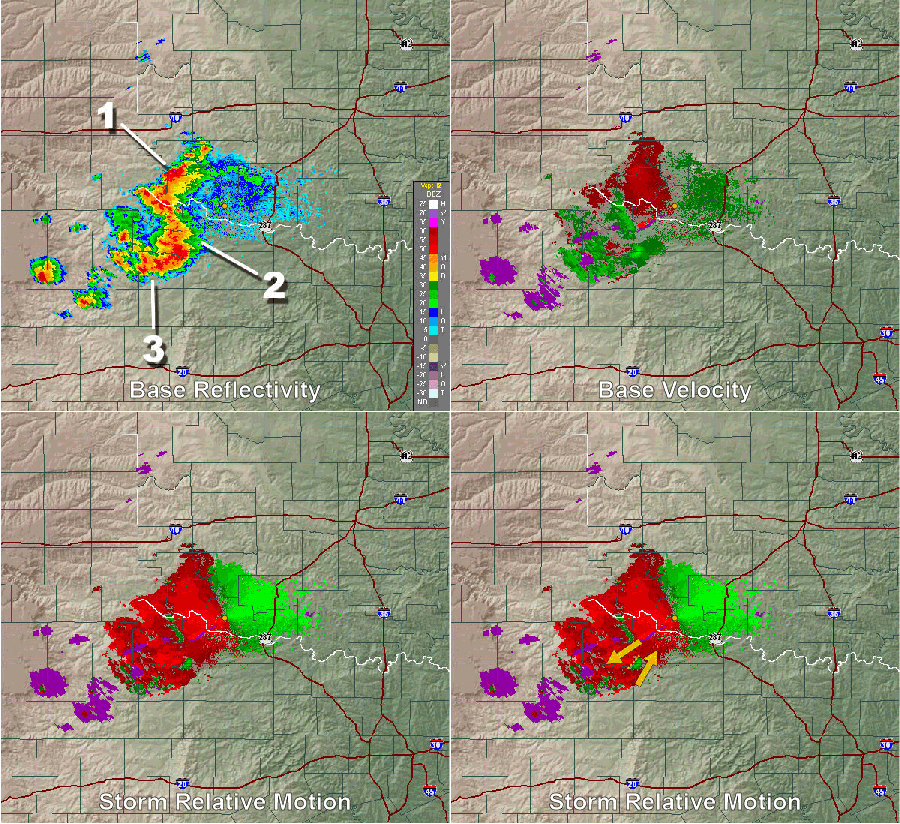
A loop of the Base Reflectivity, Base Velocity and Storm Relative Motion images to help investigate the storm located at #2.
Just judging from the base velocity image, it might appear that there is only a strong inbound motion of gusty wind produced by the thunderstorm. However, when the storm relative motion image is teamed with the base velocity there is a clearer picture of the weather situation indicating a rotating thunderstorm. This is why no one radar image will provide a complete picture of the weather.
Radar Images: Precipitation
There are two precipitation images made available via the web: One-hour Precipitation and Storm Total Precipitation. These are estimated accumulations only.
The maximum range of these two images is 124 nautical miles (143 statute miles/230 kilometers) from the radar location. They will not display accumulated precipitation more distant than 124 nautical miles, even though precipitation may be occurring at greater distances. To determine accumulated precipitation at greater distances you should look at adjacent radars.
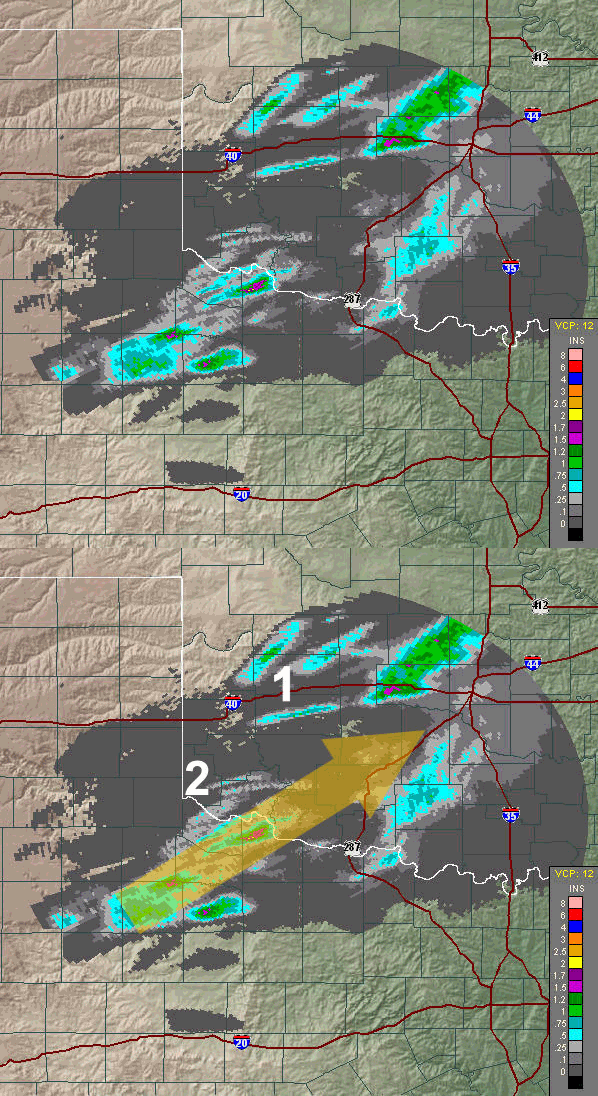
One Hour Precipitation
A One Hour Precipitation image.
Just as the name implies, this is an image (above) of the estimated precipitation during the previous hour.
But also as in the case of other Doppler radar images, there needs to be some caution in viewing this image as there are two main factors to consider.
First, while the radar does a great job at correcting itself, there are times when the radar will be out of calibration. If the radar is "hot" (reporting echoes too strong) then the rainfall estimates will be an overestimate.
Conversely, a "cool" radar will underestimate the precipitation. Always check nearby radars to see if they are reporting similar information to what is viewed by your local radar.
Second, hail makes an excellent reflector of energy. Thunderstorms with hail will overestimate the amount of precipitation and the larger the hailstones, the greater the overestimate.
Besides estimating rainfall, both the static and looping One-hour Precipitation images can provide other useful information. This image is a good way to track individual storms.
The overall motion of the storms is indicated by the large yellow arrow. However at #1 (above) there are storms moving in three directions. The first thing to notice is storms DO NOT always move parallel to the upper level winds. Some storms can move left, or right, of the upper level flow.
Thunderstorms also do not always move in straight lines. Sometimes they curve as in the case of the two small storms to the right of #2. This is valuable information as storms that tend to move right of the main airflow, either in a straight line or curved path, are often capable of producing severe weather.
These "right movers" may be difficult to see on looping Base Reflectivity images but the rainfall pattern they leave behind can be invaluable in knowing which storms require extra attention.
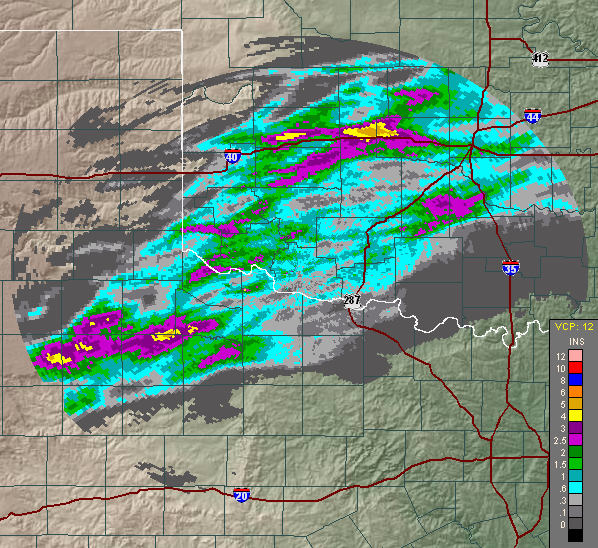
Storm Total Precipitation
Just as the name implies, this is an image (below) of the estimated accumulation since the precipitation began.
A Storm Total Precipitation image.
The accumulation continues until there is no precipitation for one hour anywhere within the range of the radar.
Often, in prolonged rainy periods, this accumulation can exceed five days or more.
On the radar page, the accumulation time period for this image is located on the right side, just above the image. As in the case of the one-hour precipitation image the radar does a great job at correcting itself, there are times when the radar will be out of calibration.
If the radar is "hot" (reporting echoes too strong) then the rainfall estimates will be an overestimate. Conversely, a "cool" radar will underestimate the precipitation. Always check nearby radars to see if they are reporting similar information to what is viewed by your local radar.
Also, hail makes an excellent reflector of energy. Thunderstorms with hail will overestimate the amount of precipitation and the larger the hailstones, the greater the overestimate.

