




 Meteorological elements(I)
1. Air Pressure
An important characteristic of the Earth's atmosphere is its air pressure, which determines wind and weather patterns across the globe. Gravity exerts a pull on the planet's atmosphere just as it keeps us tethered to its surface. This gravitational force causes the atmosphere to push against everything it surrounds, the pressure rising and falling as Earth turns.
What Is Air Pressure?
By definition, atmospheric or air pressure is the force per unit of area exerted on the Earth’s surface by the weight of the air above the surface. The force exerted by an air mass is created by the molecules that make it up and their size, motion, and number present in the air. These factors are important because they determine the temperature and density of the air and thus its pressure.
The number of air molecules above a surface determines air pressure. As the number of molecules increases, they exert more pressure on a surface and the total atmospheric pressure increases. By contrast, if the number of molecules decreases, so too does the air pressure.
How Do You Measure It?
Air pressure is measured with mercury or aneroid barometer. Mercury barometers measure the height of a mercury column in a vertical glass tube. As air pressure changes, the height of the mercury column does as well, much like a thermometer. Meteorologists measure air pressure in units called atmospheres (atm). One atmosphere is equal to 1,013 millibars (MB) at sea level, which translates into 760 millimeters of quicksilver when measured on a mercury barometer.
An aneroid barometer uses a coil of tubing with most of the air removed. The coil then bends inward when pressure rises and bows out when pressure drops. Aneroid barometers use the same units of measurement and produce the same readings as mercury barometers, but they don't contain any of the element.
Air pressure is not uniform across the planet, however. The normal range of the Earth's air pressure is from 980 MB to 1,050 MB. These differences are the result of low and high air pressure systems, which are caused by unequal heating across the Earth's surface and the pressure gradient force.
The highest barometric pressure on record was 1,083.8 MB (adjusted to sea level), measured in Agata, Siberia, on Dec. 31, 1968. The lowest pressure ever measured was 870 MB, recorded as Typhoon Tip struck the western Pacific Ocean on Oct 12, 1979.
2. Air Temperature
Air temperature is a measure of how hot or cold the air is. It is the most commonly measured weather parameter. More specifically, temperature describes the kinetic energy, or energy of motion, of the gases that make up air. As gas molecules move more quickly, air temperature increases.
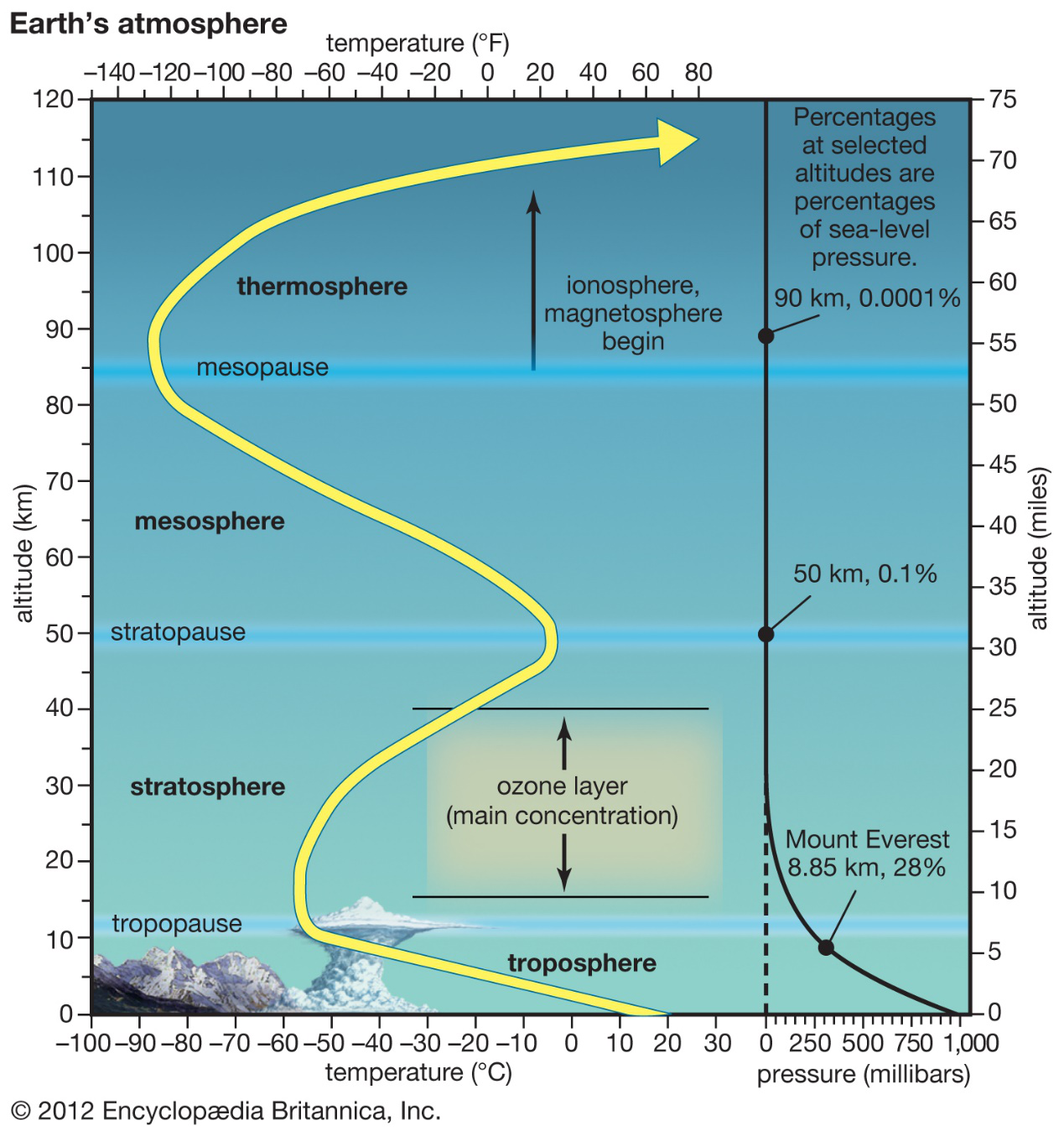
The layers of Earth's atmosphere. The yellow line shows the response of air temperature to increasing height.
Why is Air Temperature Important?
Air temperature affects the growth and reproduction of plants and animals, with warmer temperatures promoting biological growth. Air temperature also affects nearly all other weather parameters. For instance, air temperature affects:
the rate of evaporation
relative humidity
wind speed and direction
precipitation patterns and types, such as whether it will rain, snow, or sleet.
How is Air Temperature measured?
Temperature is usually expressed in degrees Fahrenheit or Celsius. 0 degrees Celcius is equal to 32 degrees Fahrenheit. Room temperature is typically considered 25 degrees Celcius, which is equal to 77 degrees Fahrenheit.
A more scientific way to describe temperature is in the standard international unit Kelvin. 0 degrees Kelvin is called absolute zero. It is the coldest temperature possible, and is the point at which all molecular motion stops. It is approximately equal to -273 degrees Celcius and -460 degrees Fahrenheit.
Air Temperature Technology
Temperature can be measured in numerous ways, including thermistors, thermocouples, and mercury thermometers. The SWMP uses thermistors, which are metallic devices that undergo predictable changes in resistance in response to changes in temperature. This resistance is measured and converted to a temperature reading in Celcius, Fahrenheit, or Kelvin.
3. Humidity
Humidity is a measurement of the amount of water vapour in the air.
Atmospheric humidity is a measure of water held in the air as a gas. Water can be solid (ice), liquid (water) or a gas (vapour). The vapour component makes up about 99% of all water held in the atmosphere. The air that we breathe is a mixture of gases - mostly nitrogen (78%) and oxygen (21%) with small amounts of carbon dioxide, argon and water vapour among other things.
Warmer air can carry more water vapour than cooler air, if there is plenty of water available. This is because it has more energy to evaporate water into vapour, and keep it in this state. The tropics are very warm and very humid - the air in the tropics contains lots of water vapour. There is very little water vapour over the very cold Arctic and Antarctic. Some very warm regions are also very dry (e.g. the deserts of the Sahara), because there is very little available water to evaporate into vapour, and at about 30 degrees north or south of the equator the air descends from above and is already very dry.
Types of humidity
The amount of water vapour in the air can be quantified in three different ways:
Relative humidity
Relative Humidity (RH) is the most common measure of humidity. It measures how close the air is to being saturated - that is how much water vapour there is in the air compared to how much there could be at that temperature. Warmer air can hold more water vapour because there is more energy available. If the RH of the air is 100% then it is fully saturated.
During a period of high temperatures, air with very high RH is very uncomfortable as the saturated air affects our body's cooling mechanism. The air cannot easily contain any more water as a vapour and so cannot effectively evaporate the sweat from our skin.
In low temperatures, air with very high RH can make us feel cooler. This is because there is more water vapour close to our skin and since water is a much better conductor than dry air, the cold temperature of the air is conducted to our skin, making us feel cooler.
Specific humidity
Specific humidity and the mixing ratio measure the actual amount of water vapour in the air as a weight in grams. They are very similar but the specific humidity is the weight of water vapour for every kilogram of air (including water vapour) whereas the mixing ratio is the weight of water vapour for every kilogram of dry air (not including water vapour).
Both the specific humidity and the mixing ratio are highest around the equator at around 20 g kg-1, where the air is warm and can hold more water vapour, and lowest (near zero) in the cold polar regions and high in the atmosphere.
Thermal humidity
'Dew point temperature' and 'wet bulb temperature' are also measures of humidity. These are both measures of how close the air is to being saturated. If they are equal to the actual air temperature then the air is saturated and RH is 100 %.
The wet bulb temperature is the traditional way of measuring humidity. It is measured by allowing the air to cool a thermometer exposed to water by evaporation.
The dew point temperature is measured by cooling a surface to the point at which the air condenses out some water vapour - this is the temperature at which the air has become saturated and is akin to the dew seen on grass in early mornings when the temperature has dropped over night.
4. Visibility
In meteorology, visibility is a measure of the distance at which an object or light can be clearly discerned. It is reported within surface weather observations and METAR code either in meters or statute miles, depending upon the country. Visibility affects all forms of traffic: roads, sailing and aviation. Meteorological visibility refers to transparency of air: in dark, meteorological visibility is still the same as in daylight for the same air.
ICAO Annex 3 Meteorological Service for International Air Navigation contains the following definitions and note:
a) the greatest distance at which a black object of suitable dimensions, situated near the ground, can be seen and recognized when observed against a bright background;
b) the greatest distance at which lights of 1,000 candelas can be seen and identified against an unlit background.
Note. — The two distances have different values in air of a given extinction coefficient, and the latter b) varies with the background illumination. The former a) is represented by the meteorological optical range (MOR).
Annex 3 also defines Runway Visual Range (RVR) as:
The range over which the pilot of an aircraft on the centre line of a runway can see the runway surface markings or the lights delineating the runway or identifying its centre line.
In extremely clean air in Arctic or mountainous areas, the visibility can be up to 160 km (100 miles) where there are large markers such as mountains or high ridges. However, visibility is often reduced somewhat by air pollution and high humidity. Various weather stations report this as haze (dry) or mist (moist). Fog and smoke can reduce visibility to near zero, making driving extremely dangerous. The same can happen in a sandstorm in and near desert areas, or with forest fires. Heavy rain (such as from a thunderstorm) not only causes low visibility, but the inability to brake quickly due to hydroplaning. Blizzards and ground blizzards (blowing snow) are also defined in part by low visibility.
Fog
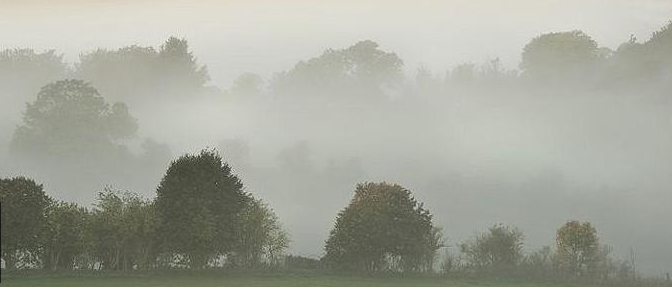
Fog is essentially a cloud at ground level that causes a reduction in visibility to less than 1000 m. However, for most people, thick fog is when visibility drops below 180 m. Severe disruption to transport occurs when the visibility falls below 50 m over a wide area. This is referred to as dense fog.
What causes fog?
Fog is caused by tiny water droplets suspended in the air. The thickest fogs tend to occur in industrial areas where there are many pollution particles on which water droplets can grow.
What are the different types of fog?
Fogs which are composed entirely or mainly of water droplets are generally classified according to the physical process which produces saturation or near-saturation of the air. The main types of fog are:
Radiation fog
Radiation fog usually occurs in the winter, aided by clear skies and calm conditions. The cooling of land overnight by thermal radiation cools the air close to the surface. This reduces the ability of the air to hold moisture, allowing condensation and fog to occur. Radiation fogs usually dissipate soon after sunrise as the ground warms. An exception to this can be in high elevation areas where the sun has little influence in heating the surface.
Valley fog
Valley fog forms where cold dense air settles into the lower parts of a valley condensing and forming fog. It is often the result of a temperature inversion with warmer air passing above the valley. Valley fog is confined by local topography and can last for several days in calm conditions during the winter.
Advection fog
Advection fog occurs when moist air passes over a cool surface and is cooled. A common example of this is when a warm front passes over an area with snow cover. It is also common at sea when moist tropical air moves over cooler waters. If the wind blows in the right direction then sea fog can become transported over coastal land areas.
Upslope fog
Upslope fog or hill fog forms when winds blow air up a slope (called orographic uplift). The air cools as it rises, allowing moisture in it to condense.
Evaporation fog
Evaporation fog is caused by cold air passing over warmer water or moist land. It often causes freezing fog, or sometimes frost. When some of the relatively warm water evaporates into low air layers, it warms the air causing it to rise and mix with the cooler air that has passed over the surface. The warm, moist air cools as it mixes with the colder air, allowing condensation and fog to occur.
Evaporation fog can be one of the most localised forms of fog. It can happen when:
Cold air moves over heated outdoor swimming pools or hot tubs, where steam fog easily forms.
Cold fronts or cool air masses move over warm seas. This often occurs in autumn when sea temperatures are still relatively warm after the summer, but the air is already starting to cool.
5. Wind
5.1 Introduction to Wind
Pressure at the earth's surface is a measure of the 'weight' of air pressing down on it. The greater the mass of air above us, the higher the pressure we feel, and vice-versa. The importance of this is that air at the surface will want to move from high to low pressure to equalise the difference, which is what we know as wind.
So wind is caused by differences in atmospheric pressure - but why do we get these differences? It's down to the rising and sinking of air in the atmosphere. Where air is rising we see lower pressure at the earth's surface, and where it's sinking we see higher pressure. In fact if it weren't for this rising and sinking motion in the atmosphere then not only would we have no wind, but we'd also have no weather.
Types of wind
This rising and sinking of air in the atmosphere takes place both on a global scale and a local scale:
Small-scale winds
One of the simplest examples of a local wind is the sea breeze. On sunny days during the summer the sun's rays heat the ground up quickly. By contrast, the sea surface has a greater capacity to absorb the sun's rays and is more difficult to warm up - this leads to a temperature contrast between the warm land and the cooler sea.
As the land heats up, it warms the air above it. The warmer air becomes less dense than surrounding cooler air and begins to rise, like bubbles in a pan of boiling water. The rising air leads to lower pressure over the land. The air over the sea remains cooler and denser, so pressure is higher than inland. So we now have a pressure difference set up, and air moves inland from the sea to try and equalise this difference - this is our sea breeze. It explains why beaches are often much cooler than inland areas on a hot, sunny day.
Large-scale winds
A similar process takes place on a global scale. The sun's rays reach the earth's surface in Polar Regions at a much more slanted angle than at equatorial regions. This sets up a temperature difference between the hot equator and cold poles. So the heated air rises at the equator (leading to low pressure) whilst the cold air sinks above the poles (leading to high pressure). This pressure difference sets up a global wind circulation as the cold polar air tries to move southwards to replace the rising tropical air. However, this is complicated by the earth's rotation (known as the Coriolis Effect).
Air that has risen at the equator moves polewards at higher levels in the atmosphere then cools and sinks at around 30 degrees latitude north (and south). This leads to high pressure in the subtropics. This sinking air spreads out at the earth's surface - some of it returns southwards towards the low pressure at the equator (known as trade winds), completing a circulation known as the Global circulation patterns.
Another portion of this air moves polewards and meets the cold air spreading southwards from the Arctic (or Antarctic). As the warm air is less dense than the polar air it tends to rise over it - this rising motion generates low-pressure systems which bring wind and rain to our shores. This part of the global circulation is known as the mid-latitude cell, or Global circulation patterns.
Another important factor is that the Coriolis effect from the earth's rotation means that air does not flow directly from high to low pressure - instead it is deflected to the right (in the northern hemisphere - the opposite is true in the southern hemisphere).
5.2 Wind Speed and Direction
Wind speed describes how fast the air is moving past a certain point. This may be an averaged over a given unit of time, such as miles per hour, or an instantaneous speed, which is reported as a peak wind speed, wind gust or squall.
Wind direction describes the direction on a compass from which the wind emanates, for instance, from the North or from the West.
Why is Wind Speed and Direction Important?
Wind speed and direction are important for monitoring and predicting weather patterns and global climate. Wind speed and direction have numerous impacts on surface water. These parameters affect rates of evaporation, mixing of surface waters, and the development of seiches and storm surges. Each of these processes has dramatic effects on water quality and water level.
How is Wind Speed and Direction measured?
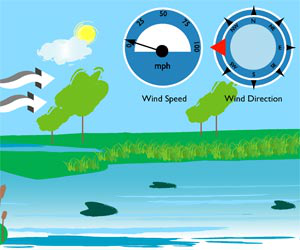
Wind speed is typically reported in miles per hour, knots, or meters per second. One mile per hour is equal to 0.45 meters per second, and 0.87 knots.
Wind direction is typically reported in degrees, and describes the direction from which the wind emanates. A direction of 0 degrees is due North on a compass, and 180 degrees is due South. A direction of 270 degrees would indicate a wind blowing in from the west.
Wind Speed and Direction Technology
The measurement of wind speed is usually done using a cup or propeller anemometer, which is an instrument with three cups or propellers on a vertical axis. The force of the wind causes the cups or propellers to spin. The spinning rate is proportional to the wind speed
Wind direction is measured by a wind vane that aligns itself with the direction of the wind.
5.3 Beaufort Wind Scale
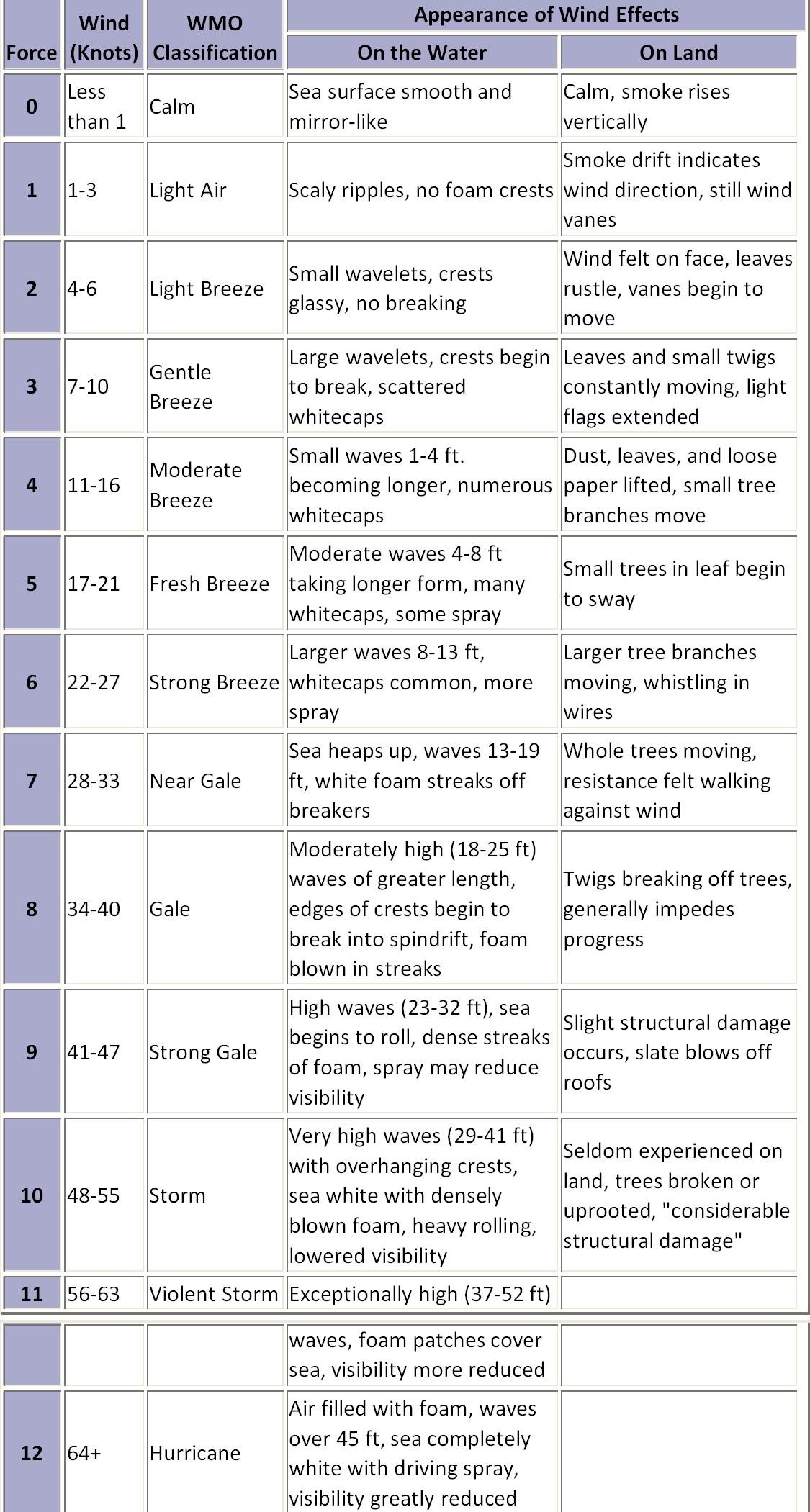
Developed in 1805 by Sir Francis Beaufort, U.K. Royal Navy