





 Weather Phenomenon(I)
1. Rain
There has always been the same amount of water on the earth, but the amount floating around in the air as water vapour or clouds depends on how warm it is. Warmer air holds more water while colder air holds less, Warm air can hold more moisture than cool air, so when the warmer air is cooled and the moisture condenses, it often rains more heavily. This is an important factor when it comes to how heavy a rainfall is.
When water on the Earth's surface is heated by the Sun, it evaporates and turns into water vapour which rises into the air. When the air cools it condenses around some dust or other particles in the air, these are called condensation nuclei. These small droplets then become visible as clouds. Some droplets fall through the cloud and coalesce into raindrops on their way down. As more and more droplets join together they become too heavy and fall from the cloud as rain.
Different types of rain have different types of names depending on the temperature of the air and where the cloud has formed. Frontal rain is one type of rain that is affected by the temperature of the air. It comes from clouds that form when warm, moist air glides up and over fronts. At a cold front, cold air advances beneath the warm air, lifting it up and producing heavy cloud and intense rain. In the summer these can create severe thunderstorms. At a warm front the rain is lighter because the warm air advances and rises over the cold air. Frontal rain occurs mainly in mid-latitude regions where warm tropical air meets cold polar air. Another type of rain is Orographic rain which is produced in response to the topography of the land. As an air mass blows from the sea over hilly land the damp air rises and condenses. Above the orographic cloud is a rain cloud that forms over the sea and is called a seeder cloud. Rain from this cloud falls through the cloud below it and washes many of the tiny cloud droplets out. This means that hilly coastal land is wetter then lower coastal areas.
2. Snow
Snow is defined as 'solid precipitation which occurs in a variety of minute ice crystals at temperatures well below 0 °C but as larger snowflakes at temperatures near 0 °C'. It is one of the most striking weather phenomena causing a transformation of the world around us, but it can also lead to the potential for disruption.
How does snow form?
Snow forms when tiny ice crystals in clouds stick together to become snowflakes. If enough crystals stick together, they'll become heavy enough to fall to the ground.
Snowflakes that descend through moist air that is slightly warmer than 0 °C will melt around the edges and stick together to produce big flakes. Snowflakes that fall through cold, dry air produce powdery snow that does not stick together.
Snow is formed when temperatures are low and there is moisture in the atmosphere in the form of tiny ice crystals.
How cold does it have to be to snow?
Precipitation falls as snow when the air temperature is below 2 °C. It is a myth that it needs to be below zero to snow. The falling snow does begin to melt as soon as the temperature rises above freezing, but as the melting process begins, the air around the snowflake is cooled.
Snowfall can be defined as 'slight', 'moderate' or 'heavy'. When combined with strong winds, a snowfall can create blizzards and drifts.
If the temperature is warmer than 2 °C then the snowflake will melt and fall as sleet rather than snow, and if it's warmer still, it will be rain.
‘Wet’ snow vs. ‘dry’snow
The size and make up of a snowflake depends on how many ice crystals group together and this will be determined by air temperatures. Snowflakes that fall through dry, cool air will be small, powdery snowflakes that don't stick together. This 'dry' snow is ideal for snow sports but is more likely to drift in windy weather.
When the temperature is slightly warmer than 0 °C, the snowflakes will melt around the edges and stick together to become big, heavy flakes. This creates 'wet' snow which sticks together easily and is good for making snow men.
3. Frost
Frost is normally formed on still, clear and cold nights. The cool air causes water vapour in the air to condense and form droplets on the ground. When the temperature of the ground or surface is below 0 °C the moisture freezes into ice crystals - known as the frost point.
Types of Frost
Ground frost
A ground frost refers to the formation of ice on the ground, objects or trees, whose surface have a temperature below the freezing point of water. During situations when the ground cools quicker than the air, a ground frost can occur without an air frost. A grass frost, an un-official type of ground frost, can occur when other surfaces - such as concrete or road surfaces - don't experience a frost, due to their better ability at holding onto any warmth. It is possible for a grass frost to occur in late spring or even early summer when the risk of more wide-spread frosts has disappeared and is something that gardeners in particular need to be aware of.
Air frost
An air frost occurs when the air temperature falls to or below the freezing point of water. An air frost is usually defined as the air temperature being below freezing point of water at a height of at least one metre above the ground.
Hoar frost
Hoar frost is composed of tiny ice crystals and is formed by the same process as dew, but when the temperature of the surface is below freezing point. The 'feathery' variety of hoar frost forms when the surface temperature reaches freezing point before dew begins to form on it. A 'white' frost, composed of more globular ice, occurs when the dew forms first, then subsequently freezes. The presence of fog tends to prevent the formation of hoar frost as it reduces the potential for radiational cooling of surfaces.
Glaze and rime
Frost is sometimes confused with glaze or rime.
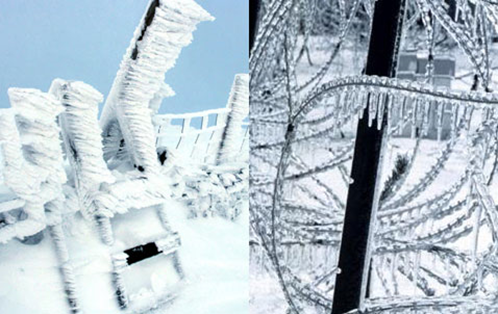
Rime is a rough white ice deposit which forms on vertical surfaces exposed to the wind. It is formed by supercooled water droplets of fog freezing on contact with a surface it drifts past.
Glaze can only form when supercooled rain or drizzle comes into contact with the ground, or non-supercooled liquid may produce glaze if the ground is well below 0 °C. Glaze is a clear ice deposit that can be mistaken for a wet surface and can be highly dangerous.
4. Dew
Dew is the small droplets of water that appear on objects such as leaves or grass in the morning or evening due to processes of condensation.

How does dew form?
Dew forms when the temperature of a surface cools down to a temperature that is cooler than the dew point of the air next to it. When this happens water vapour will condense into droplets depending on the temperature. The temperature at which droplets form is called the dew point. When surface temperature drops, eventually reaching the dew point, atmospheric water vapour condenses to form small droplets on the surface.
Up to 0.5mm of dew can form at night in some climates. Whilst small, this amount is significant enough for dew to become an important source of moisture for some plants and animals in arid areas. Dew can be collected for human use from canopies erected above the surface which with the correct conditions can collect several litres of water.
Dew forms most easily on surfaces that do not conduct heat from the ground - grass and the rooftops of cars are some of the most frequently seen examples. It usually forms during the calm weather associated with high-pressure systems.
Dew point
The temperature at which condensation occurs is called the Dew point and is dependent upon the humidity and pressure of the air. Calculating the exact value of the dew point is important when predicting frost or fog.
Dew point may be measured indirectly from wet-bulb and dry-bulb temperature readings with the aid of a humidity slide-rule or humidity tables, or directly with a 'dew-point hygrometer.
Dew bow
Whilst a relatively rare occurrence, the presence of dew can cause a similar optical effect to a rainbow.
An example is in the picture below caused by drops of dew hanging on a spiders web reflecting and dispersing sunlight.
5. Fog
For fog to form we need a few ingredients; moisture, light winds and a certain temperature called the ‘fog point’.
We know that fog is essentially a very low-lying cloud, and that for clouds to form the air must be cooled to a point where its moisture condenses out into a visible cloud. The cooling normally occurs as air rises, but in the case of fog we have to wait for the air to cool down to its fog point naturally. This will be very dependent on the time of year, how much cloud cover there is, the strength of the wind, the amount of moisture in the air and the geographical location.
The main types of fog are radiation, valley, advection, upslope and evaporation. Here we look at radiation fog, and the ideal conditions for its formation are clear skies, light winds and plenty of moisture. If there is a high moisture content in the air, the temperature will not have to fall as far to reach the fog point and there will be a greater risk of fog forming. This is often why fog forms more readily around lakes, rivers and reservoirs.
Winds need to be gentle enough to keep the moisture in the air at the right concentration. Too light and it’ll form dew; too strong and the moisture will be mixed through the air and probably keep temperatures too high.
Clear skies at night allow temperatures to drop as heat escapes more readily from the Earth’s surface. With the right wind, moisture and lack of cloud, the fog point will be reached.
However, in order to forecast the fog point for the coming night we need to know the maximum temperature reached during the day. Bearing in mind we may be forecasting fog a few days ahead, the maximum temperature will also need to be forecast.
To do this we must consider; the amount of sunshine and how strong the sun is at a particular time of year, the wind speed and direction and whether they will change, how much cloud there is, whether there will be any rain, how much heat the ground has absorbed, and so on.
If any of those variables is different, even by a small amount, it will have a knock on effect throughout the forecast. With so many factors at play, it’s easy to see that fog is one of the trickiest weather phenomenon to forecast.
6. Smog
Smog is a kind of air pollution, originally named for the mixture of smoke and fog in the air.
Classic smog results from large amounts of coal burning in an area and is caused by a mixture of smoke and sulfur dioxide.
In the 1950s a new type of smog, known as Photochemical Smog, was first described.
Smog is a problem in a number of cities and continues to harm human health.
Ground-level ozone, sulfur dioxide, nitrogen dioxide carbon monoxide are especially harmful for senior citizens, children, and people with heart and lung conditions such as emphysema, bronchitis, and asthma.
It can inflame breathing passages, decreasing the lungs' working capacity, and causing shortness of breath, pain when inhaling deeply, wheezing, and coughing.
It can cause eye and nose irritation and it dries out the protective membranes of the nose and throat and interferes with the body's ability to fight infection, increasing susceptibility to illness.
Hospital admissions and respiratory deaths often increase during periods when ozone levels are high.
EPA in the U.S. has developed an Air Quality index to help explain air pollution levels to the general public. 8 hour average ozone concentrations of 85 to 104 ppbv are described as "Unhealthy for Sensitive Groups", 105 ppbv to 124 ppbv as "unhealthy" and 125 ppb to 404 ppb as "very unhealthy." Smog can form in almost any climate where industries or cities release large amounts of air pollution.
However, it is worse during periods of warmer, sunnier weather when the upper air is warm enough to inhibit vertical circulation.
It is especially prevalent in geologic basins encircled by hills or mountains.
It often stays for an extended period of time over densely populated cities or urban areas, such as London, New York, Los Angeles, Mexico City, Houston, Toronto, Athens, Beijing, Hong Kong, the Randstad or Ruhr Area and can build up to dangerous levels.
7. Heat Wave
Heat wave, also called heatwave, period of prolonged abnormally high surface temperatures relative to those normally expected. Heat waves may span several days to several weeks and are significant causes of weather-related mortality, affecting developed and developing countries alike. Globally, the increasing frequency and intensity of heat waves observed since the 1950s has been associated with climate change. Such weather phenomena may be characterized by low humidity, which may exacerbate drought, or high humidity, which may exacerbate the health effects of heat-related stress, which include heat exhaustion, dehydration, and heatstroke.
No formal, standardized definition of a heat wave exists. The World Meteorological Organization defines it as five or more consecutive days during which the daily maximum temperature surpasses the average maximum temperature by 5 °C (9 °F) or more. Some countries have adopted their own standards. For example, the India Meteorological Department requires that temperatures increase 5–6 °C (9–10.8 °F) or more above the normal temperature, whereas the U.S. National Weather Service defines a heat wave as a spell of “abnormally and uncomfortably hot and unusually humid weather” spanning two days or more.
Oppressively hot and humid air masses lingering over populated areas can produce many deaths, especially in the middle latitudes, where many people—including the very young, the very old, and those with health problems—may be more susceptible to heat stress. Notable modern episodes include the Russian heat wave of 2010 (which covered 1,036,000 square km [400,000 square miles] and killed 55,000 people), the European heat wave of 2003 (in which more than 30,000 people died), the U.S. heat wave and drought of 1988 (which killed more than 4,000 people), and the Indian heat wave of 2015 (which killed more than 2,500 people).

